Showing posts with label toxins. plastic bottles. Show all posts

Saturday, 3 March 2018

Cancer-Causing Toxins Lurking in Household Cleaning Products

Cancer-Causing Toxins Lurking in Household Cleaning Products


Have you ever walked down the cleaning and laundry soap aisle in your local grocery store and been assaulted with so many fragrances you wanted to run the other way? All of those concentrated chemical scents are pretty hard to take – especially if you suffer from allergies – and it isn’t just an assault on your nose.
Fragranced consumer products in the form of soaps, cleaners, air fresheners, hand sanitizers, laundry detergents, and personal care products are widespread in society. Studies have repeatedly shown that the synthetic fragrances and other toxic chemicals included in these products are causing a range of health problems for humans. They’re also harming wildlife and contributing to environmental pollution.

Carcinogens Found in Popular Laundry Products & Air Fresheners

Professor Anne Steinemann from the University of Washington (UW) in the U.S. studies the impact of synthetic fragrances on health. She became interested in the problem when people started suggesting to her that the air fresheners in public restrooms and the fragrances coming from laundry and cleaning products were making them sick. Through a series of investigative studies over a period of several years, Steinemann and her colleagues discovered that synthetic fragrances were just the tip of the iceberg causing health problems for people.
In 2008, Steinemann and a team of researchers at UW investigated six of the top-selling laundry products and air fresheners. They wanted to discover what exactly they contained that might be contributing to health issues. Because the manufacturers who create these products are not required to disclose the ingredients, each product was separately analyzed to determine what was in them. What they found was alarming…
Of the six products, almost 100 chemicals were found, some of them identified as toxic or hazardous under federal law. None of the ingredients were listed on the product label, and there were no warnings. According to Steinemann, five of the six productsreleased one or more carcinogenic “hazardous air pollutants,” which are considered by the United States Environmental Protection Agency (EPA) to have NO safe exposure level.

Could Your Dryer Vent Be Making You Sick?

In 2011, the same team of researchers performed a controlled study investigating the emissions from washing machines and dryers. The emissions were sampled from two residential dryer vents during the use of:
  • no products
  • detergent with fragrance
  • detergent and dryer sheets, both with fragrance
The researchers found more than 25 volatile organic compounds (VOCs) were emitted from dryer vents, with high concentrations of the chemicals acetaldehyde, acetone, and ethanol. Seven of these VOCs were classified as hazardous air pollutants and two as carcinogenic (acetaldehyde and benzene).

Toxic Chemicals Affect 99% of the U.S. Population

In 2016 Prof Steinemann wrote an article that was published in the journal Air Quality, Atmosphere & Health. The article reported results from a national population survey of Americans looking into the range of exposures and effects associated with the emissions from fragranced products. Steinemann reported:
Collectively, 99.1 percent of the population are exposed to fragranced products at least once a week from their own use, others’ use, or both.
An astounding 34.7% of the population reported health problems attributable to this exposure, including:
  • respiratory difficulties
  • neurological problems
  • asthma attacks
  • dizziness
  • migraine headaches
A worrying 15.1% of the population lost work days or even their job due to the effects from fragranced product exposure on the job.

The Worst Chemical Offenders in Cleaning Supplies

The toxic chemicals routinely being included in laundry detergents, air fresheners, and other cleaning products can affect not only our personal health but also the environment. These chemicals are emitted into the air and contribute to air pollution. They go down the drain and into bodies of water and create havoc in our waterways and streams. The animals that drink this water are adversely affected. The fish that swim in this water are also under stress.
Some of the most damaging chemicals found in cleaning supplies are:
Synthetic fragrances – A fragrance in a product is typically a mixture of several dozen to several hundred chemicals, most of which have not been evaluated for their safety. The combination of the chemicals used can be carcinogenic if inhaled or worn close to the skin – which is of course what happens.
Stabilizers – Included to help stabilize the formula for longer shelf life. Examples include ethylene oxide or polyalkylene oxide, linked with eye, skin, and lung irritation, as well as rashes and dermatitis.
Surfactants – Included to help the product clean better. Examples include sodium lauryl sulfate (SLS), which has a long list of health concerns including organ toxicity, developmental and reproductive problems, neurotoxicity, possible mutations, and cancer; diethanolamine (DEA), linked with eye and skin irritation and possibly liver problems; quaternium-15, known to release formaldehyde, a known carcinogen; linear alkyl benzene sulfonates (LA), linked with eye and skin irritation and toxic to aquatic life; benzene, a known carcinogen; petroleum distillates, linked to lung damage and cancer.
1,4 dioxane – A by-product of sodium lauryl sulfate linked to respiratory problems, allergies, hormone disruption, kidney disease, nervous system disorders, brain toxicity, liver disease, and immune system impairment.
Bleach: Either separately or included in a detergent formula, bleach is a known skin, eye and lung irritant. Worse, when it combines with waste water, toxic organic compounds are formed that are known to cause respiratory problems as well as kidney and liver damage.
Phosphates and EDTA: Included in formulas to soften hard water, remove grease and dirt, and suspend dirt so that it doesn’t settle back on clothes or dishes during the wash cycle. Phosphates have long been associated with environmental damage – especially in waterways – causing algal blooms that cause widespread damage to ecosystems. Many detergent manufacturers have eliminated phosphates, but the replacement, ethylenediaminetetraacetic acid (EDTA) is not much better. It does not readily break down in the environment (biodegrade), and animal studies have found it to be toxic.
Optical Whiteners: Chemicals that remain on the surface of fabric to absorb UV light and help clothing appear brighter, whiter, and more vibrant; an optical illusion. Optical brighteners are linked with contact dermatitis and possible genetic mutations in aquatic life, according to one Swedish study. They are not biodegradable.
There are many other chemicals in cleaners and other household products – these are just the worst offenders. As a direct result of the presence of these chemicals in the average home, the EPA has reported that the air inside these homes is two to five times more polluted than the air immediately outside them!

Why Doesn’t the Government Protect Us?

The United States Consumer Product Safety Commission, the regulating body for laundry products, air fresheners, and cleaning supplies in America, does not require manufacturers to disclose any of the ingredients on the product label. That also holds true for the inclusion of fragrances in personal care products, which are overseen by the United States Food and Drug Administration.
Many of the chemicals used in cleaning products have not been tested for safety, particularly in combination with other chemicals. Frustratingly, some chemicals proven beyond a shadow of doubt to be harmful are still being used. It appears that only once it has been decided by the regulatory agency responsible for a particular chemical type that it could present an “unreasonable risk to human health or the environment” can that chemical be banned. This “innocent until proven guilty” approach to toxic chemicals is nowhere near good enough to protect us.
In 2009, U.S. Senator Alan Franken sponsored a bill entitled The Household Product Labeling Act, which would have required manufacturers to label consumer products with all ingredients, including fragrances. Unfortunately, the bill was not passed.
As usual, it is up to us as health-conscious consumers to educate ourselves on the hazards of common household cleaners and products and to make better, wiser choices. Unfortunately you’ll to do your research carefully as even some self-proclaimed “green” or “natural” cleaning products contain health-harming ingredients.

Is it REALLY Safe to Drink Bottled Water?

Bottled water is sold all over the world. Available in grocery and convenience stores, restaurants, recreation centers, schools, gas stations, and almost everywhere… bottled water is a staple stock item. But is bottled water safe?
In recent years there has been a lot of controversy about water. Some say the water in the bottles, even in fancy labeled brands claiming to come from far away mountain springs, is actually from city tap water. Others say that city tap water is actually good for you because it’s fluoridated and fluoride is good for your teeth − especially children’s teeth.
But what is the truth about bottled water? And how safe is plastic, really? And how are these chemicals impacting your health?
In this article I will be shedding some light on these very important questions.
As a child, I remember my teacher in school getting us to memorize this famous slogan: “reduce, reuse, recycle.” Now, the majority of Americans know they should recycle their plastic bottles. But where does all this plastic come from in the first place?
Over 60 million water bottles are thrown away each day in the United States alone and only a small percentage of these (around one in six) get recycled. No wonder so many chemicals are being leached into our precious soil. Imagine the environmental impact this has.
Bottled water is a trillion dollar industry. How does that affect the environment and our drinking water? If the toxic chemicals are leaching into the soil, how much more is going into our rivers and lakes? Could there be a connection too between our drinking water and cancer?

3 Hazards Commonly Found in Plastic Water Bottles

1. Bisphenol A (BPA)

Bisphenol A (BPA) is a chemical that Big Industry uses to stabilize epoxy resins and polycarbonate plastics or hard plastics. It is also used in softer plastics to prevent cracking.
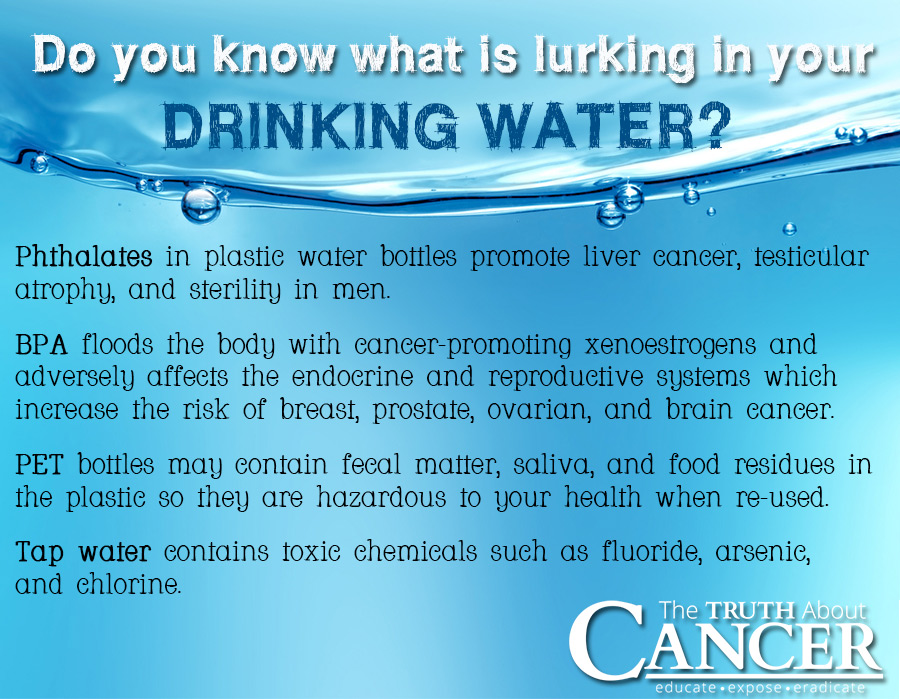
What does that have to do with your drinking water? It’s important to know that the plastic used for bottled water often contains BPA. It’s known to leach into the water when exposed to heat, which in turn creates “faux estrogen” or what is also known as bad estrogen. High levels of circulating bad estrogen is recognized as a cause of ovarian, prostate, and breast cancers.
Furthermore, BPA has been found to adversely affect fetuses, infants and children’s brains, and prostate glands. Behavior disorders are also prevalent from BPA contamination leading to hyperactivity and aggression in children.
BPA is used in plastic containers for food, and the linings of cans of infant formula and many food products. Again the problem is the leaching of the chemicals into the food − especially if it is microwaved. When you eat foods from these containers, you’re at risk of being poisoned by this dangerous chemical. Some say that it is such a small amount that the effects are negligible. But many researchers are now pointing out that the chemicals accumulate and are the reason for such a high concentration of BPA found in umbilical cords and soft tissues in the body.
BPA also affects marine life in freshwater in a similar fashion as humans. It gets in the air from evaporation out of contaminated water so it’s possible to get more doses via breathing infected air. Finally, it is used in paper receipts so whenever we touch them we get a small dose of BPA. All these small sources add up over time to a large dose that accumulates in the body and can lead to the following health hazards.
BPA has been found to adversely affect the endocrine and reproductive systems and to increase the risk of breast, prostate, ovarian, and brain cancer. It also increases the occurrence of hyperactivity, attention deficit disorder, aggressive behavior, and asthma.
These problems can be prevented if we use glass and stainless steel containers instead of plastic. It’s important to take a stand and push for the discontinued use of BPAs to protect our environment and our bodies.

2. Polyethylene terephthalate (PET)

PET bottles are BPA-free but they pose other potential health risks. According to the North Dakota State University reports, PET bottles contain contaminants of fecal matter, saliva, and food residues in the plastic so they are hazardous to your health when re-used. This is primarily as a result of the soft plastic which is nearly impossible to clean, thus the reason for the significant presence of contaminants after multiple usage.

3. Phthalates

Phthalates are another chemical compound used to make plastic flexible, particularly PVC (polyvinyl chloride). These also leach into the water contained in their bottles or water supplied by PVC pipes. The problems they cause in humans include: liver cancer, testicular atrophy, and sterility in males.

How Do You Know What’s in Your Plastic Water Bottle?

How do you know what kind of plastic was used in the various brands of water bottles? In my opinion, there is no way that you can be certain whether the plastic used was free from contaminants or dangerous chemicals because bottling companies change plastics without notice. As a result I suggest avoiding plastic water bottles altogether.

Is Tap Water Better than Bottled Water?

So, the next question is…why don’t I just get rid of all this plastic bottled water nonsense and just use tap water? Since statistics show 40% of the water in bottled water is from the tap anyway… then why not?
Yes, you should use tap water. But only after you’ve filtered it with a quality filtration system, which I will discuss in a moment.is-bottled-water-safe-list-of-cancer-causing-chemicals
If you use tap water without filtration you risk contamination of heavy metals, chemicals, bacteria, and other potentially dangerous unknown substances. If you think about it, city tap water is held in massive containers that come to your home through a large network of pipes with questionable hygienic standards. Therefore, the water itself has to be treated with chlorine, fluoride, arsenic, and other unhealthy chemical poisons in order to ensure you’re getting “clean” water.
And then you might ask, “What’s wrong with that? It’s clean water after all.” The problem is the chemicals. Even in small amounts you don’t want fluoride and chlorine accumulating in your system. Yes, it’s only small quantities, but if you’re taking them in regularly it adds up to a big problem. And if you’re cooking with and showering in fluoridated and chlorinated water, it’s even worse.

How Fluoride and Chlorine Adversely Affect Your Body

Boiling water kills bacteria but concentrates the fluoride and other chemicals. This is a problem because fluoride is a neurotoxic chemical causing brain damage. Man-made fluoride has been reported by researchers to reduce IQ levels and make people more docile.
Chlorine, on the other hand, is poisonous. Pool water is a highly concentrated form and is known to cause breathing problems, red itchy eyes, swelling of the mucous membranes, dizziness, headaches, and more in many people.
If you are sitting near the pool sunbathing you will be breathing in the gaseous form which is highly toxic. Consistent exposure will lead to a dramatic increase of free radical damage to your skin and airways as well as hair. This means high risk for contracting cancer.
If you have your own pool you may consider using a silver-copper ion generator instead. This is an issue that should be taken seriously as people who are exposed to chlorinated water are at a 93% higher risk of developing various cancers.
Breast cancer has been linked to high levels of chlorine compounds found in the breast tissue, according to a study from Hartford Connecticut. So a little chlorine to kill bacteria has gone a long way to killing humans bit by bit through the accumulation of the chemicals in the body.
Furthermore, chlorine is effective in destroying probiotics, the healthy bacteria that aids in digestion in the body. This in turn leads to digestive distress, heartburn, acid reflux, leaky gut, ulcers, constipation, and eventually gastrointestinal tract related cancers.

What about Home Water Filtration Methods?

  • Reverse Osmosis is becoming popular, but it removes minerals that need to be replaced to avoid loss of minerals due to leaching.
  • Ionized water machines boast higher energy and alkalinity to restore the body to a balanced pH. These should be used with caution, following the instructions carefully, and possibly consulting a health professional that can assist you.
  • Distilled Water is formed from boiling the water and collecting the steam in a condenser that collects the purified water in a clean container. If you distill your own water using glass and storing it in glass, then it should be okay as far as being contaminant free. But when it is ingested it leaches the minerals from the body causing all manner of mineral damage.If you purchase distilled water that has been stored in plastic bottles it contains phthalates − components of the plastic- which are dangerous for your health. It has been reported that phthalates interrupt endocrine functions in the body resulting in breast cancer, pancreatic cancer, thyroid problems, and more. So, get distilled water in glass and add minerals from quality mineral salt if you want to prevent leaching.

Is Vitamin Water a Healthy Choice?

One of the worst health scams Big Industry has come up with (other than deceptive labels on other products) is Vitamin Water. Most vitamin water contains high fructose corn syrup and food dyes which wreak havoc on the body’s delicate internal systems. Corn syrup has been linked to obesity, diabetes, and immune and metabolic disorders. It also feeds cancer and creates acidic conditions in the body that encourage bacteria growth and the proliferation of viruses as well as other chronic diseases.
Food dyes, on the other hand, are linked to various cancers, behavioral disorders, mental dysfunctions, and metabolic problems. So avoid vitamin water and other so-called “health drinks” manufactured by Big Industry. The truth is that man-made water enriched with synthetic vitamins and minerals is as bad as or worse than sodas. But at least with soda you are aware of the health risk and can limit your intake.
With supposed health drinks you are unlikely to recognize the disastrous effects until after you have been duly poisoned. Even then you may not make the connection until a serious problem occurs.
Remember, there is no man-made food or drink that can replace the thousands of vitamins, minerals, phytonutrients, and healthy bacteria found in natural, unadulterated organic whole foods.

4 Tips For Reducing Your Exposure to Toxins Released By Plastic

  1. Exchange your plastic bottles for stainless steel or glass
  2. Invest in a good quality carbon water filter and filter your tap water and store it in glass or ceramic containers
  3. Avoid cooking and heating any food or water in plastic or Styrofoam
  4. If you must eat or drink from plastic be careful not to expose the food to the sun, high heat, microwave, or cut into the plastic while you are consuming the product.

What is All this Plastic Doing to Our Environment?

With all the trillions of dollars made by selling water in plastic bottles to the public, you can see how this poses a problem to the environment if these bottles are not properly recycled.
Ask yourself this question: Where does all this plastic go?
Answer: some goes into landfills, and some into the oceans, rivers and lakes. Some stays in humans and animals.
It takes years for nature to completely break down these products even though manufacturers claim that they have a half-life of ten days. Don’t believe it! Have you seen plastic water bottles disintegrate in a few weeks? I haven’t. Rather, they seem to accumulate over a number of years. It takes a significant length of time for nature to disassemble the components of plastic. Then all the toxic matter is released into the surrounding environment to further poison our soil, water, and air.
Glass and stainless steel are reusable and do not contaminate the environment, so it is an alternative we all need to embrace with diligence.
As for the health impact, the accumulation of the toxic chemicals in the tissues and organs of the human body are carcinogenic and hazardous to our health. Why should something that takes five minutes to use be allowed to accumulate in the earth when we could use eco-friendly products that would benefit our planet?!
It’s up to us to make the change and it affects all of us. We can help to prevent a myriad of health problems by boycotting plastic use. The benefits are worth our committed efforts. Let’s stop funding Big Industry’s abuse of our planet. Together we can make it happen!

PLASTIC WATER BOTTLES CAN RELEASE CANCER-CAUSING TOXINS

PLASTIC WATER BOTTLES CAN RELEASE CANCER-CAUSING TOXINS


Fact or Fiction:
Drinking out of a plastic water bottle left in a hot car can lead to cancer?
That’s the buzz on the Internet.� It’s convient, fresh and clean.
Or is it?
“The problem with water bottles is, it’s made of plastic,” said Dr. Ravi Patel with Comprehensive Blood and Cancer Center. ”And there’s different kinds of plastic. Plastics actually release different chemicals in different situations.”
Dr.�Patel, founder of the Comprehensive Blood and Cancer Center, says heat can release cancer-causing toxins, which leak from plastic into water and even food.
There are two chemicals he says pose the biggest threat.
“Dioxin and another one, �BPA,�Bisphenol A,�These two products are connected to plastics and that has been associated with a whole host of health issues including birth defects, cancer. A variety of things,” said Dr. Patel.
17News contacted Dr. Patel after receiving an email that suggested�leaving bottled water in your car is very dangerous. The email said plastic water bottles have been�been identified as the most common cause of high levels of dioxin in breast cancer tissue.
The email claims to be from Johns Hopkins University, but when the school’s website was checked, there was�no mention of this.
Many believe it’s a hoax. But, Dr. Patel still says it’s a real possibility.
“You don’t want to wait for all the evidence to show you it causes cancer. There’s enough evidence right now that it can be carcinogens. So if it’s easy and simple to avoid the product in your life, you should try to avoid it.”
But The American Cancer Society says more research needs to be done.
“There really isn’t evidence and there�really isn’t going to be evidence soon about how these things increase individual cancer risk. The individual risk of developing cancer is going to be very very small,” said Dr. Tune with The American Cancer Society.
Though doctor Tune downplays the connection, he says high levels of BPA have been linked to an increased risk of reproductive issues, not cancer.
As we wait for more research, Dr. Patel says now is the time to start changing habits.
“I think the psychological makeup that the water bottle is the cleanest safest thing isn’t necessarily true. So, if you go ahead and look at the mug, you look at the steel mug, and then you look at the water bottle. It’s equally easy to carry. It’s an easy change to make. It could be a change that affects your family, your children, your health on a long term basis,” said Dr. Patel.
So if plastic is still your pleasure, look at the triangle on the bottom of any plastic container or water bottle.
Researchers say it’s important to stay away from anything with the number 7 or PVC.
Those products contain higher levels of chemicals.